I had spent hours—maybe days—rehearsing my speech. Sticky notes everywhere. Imagining the perfect Wolof accent.
That morning, my friend Maty Mbaye BA called. Her voice full of patience and drama.
“Emily, are you ready? Just relax.”
I tried. I really tried. However, my internal monologue had other plans.
What if I forget everything? Why do I suddenly understand why people panic at public speaking?
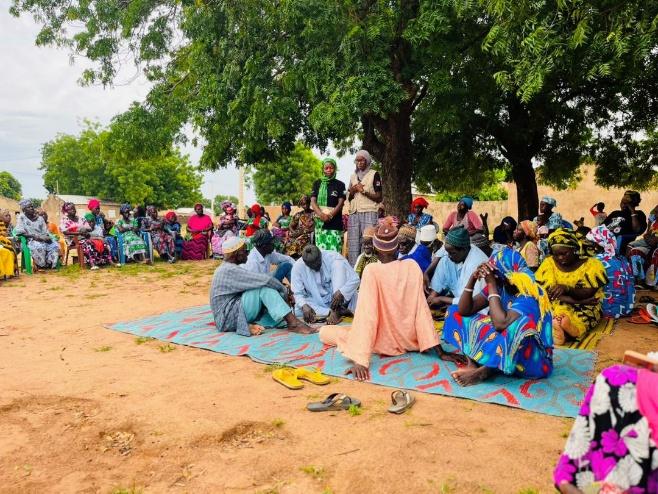
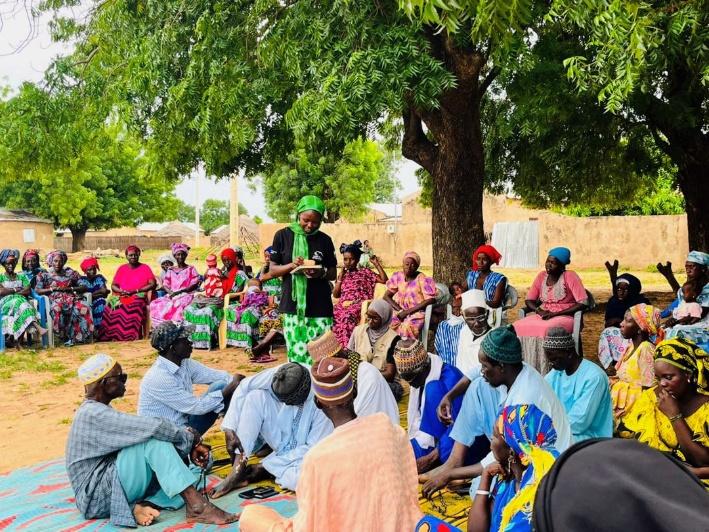
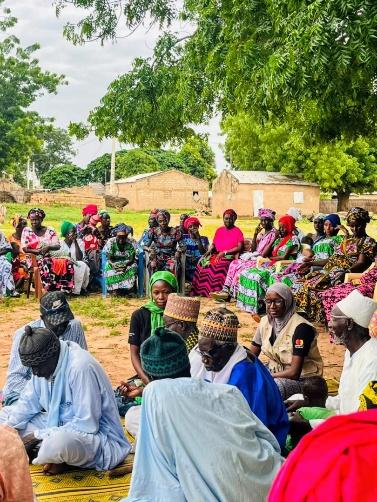
By the afternoon, the neem tree loomed over the penc mi, (the meeting place). It shaded a circle of ninety-eight women seated in bright plastic chairs.
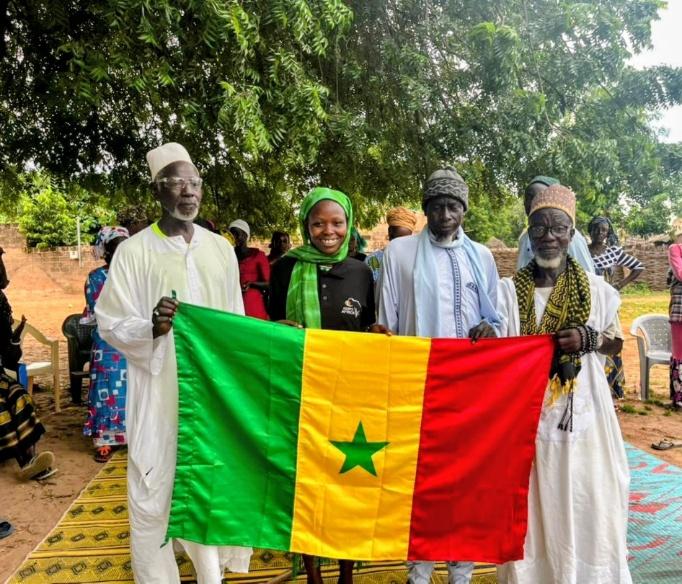
In the center, nine elders sat cross-legged on mats. Their calm eyes were steady and patient. Children’s laughter drifted nearby, their tiny feet pattered against the earth as they chased one another. Their energy wove through the gentle hum of conversation.
The air smelled of attaya tea and fresh mint. It was as if the day itself was quietly cheering me on.
The men were away tending the land. In their absence, the women filled the space with colour, conversation, and curious eyes.
This wasn’t just a meet-and-greet. It was my official introduction as a CorpsAfrica volunteer. A chance to explain why I was there, to listen, and to start building trust. My role was to learn from them, to share experiences, and to walk alongside them step by step, not lead.
And just like that, it was my turn. “Penda Ndur!”
They didn’t even remember my real name here. Or maybe they never needed to.
Since arriving in Senegal, each village had given me a new name. Each one a quiet welcome, an invitation to belong.
I clutched my notes and began. “Salaam Maalekum mbolomi, maangi tudd Penda Ndour, kontanaa nekk fi…”
My Wolof came out… confidently confused. A mix of Swahili rhythm, English melody, and pure improvisation.
Halfway through, even I wanted to clap for myself.
The elders smiled, slow and generous, as if to say, You tried, child. You really did.
My cluster mates, Kardiatou KA and Maty Mbaye BA immediately stepped in and translated my creative Wolof into smooth, coherent words. They filled in the spaces my language could not reach. They had my back.
Soon after, the women decided to put my Wolof to the test.
“Penda, nanga def?” — Penda, how are you?
“Naka wa kër gi?” — How is your home?
“Yaangi noos?” — Are you well?
I answered with my best accent.
“Mangi fi rek, maa ngi noos torop!” — I’m fine, just taking it easy!
Their laughter bubbled up, light and teasing. Each question became a game, a playful way to invite me to Siwol. Attaya invitations, handshakes, and warmth filled the air. The first threads of connection began to form.
Later in the night, I replayed the day: The sun, the sticky notes, the smiles, the new name.
It wasn’t perfect. But it was perfectly hilarious. Maybe that’s what belonging feels like.
Small steps. Soft laughter. Shared mistakes. Moments so simple, they almost slip by.
And friends like Matty whispering, “Just relax.”
I didn’t deliver a flawless speech.
I didn’t speak fluent Wolof.
I barely even got all my words right.
But I showed up. And so did they.